ECONOMIC INTELLIGENCE
Macro data only matters if it changes a decision.
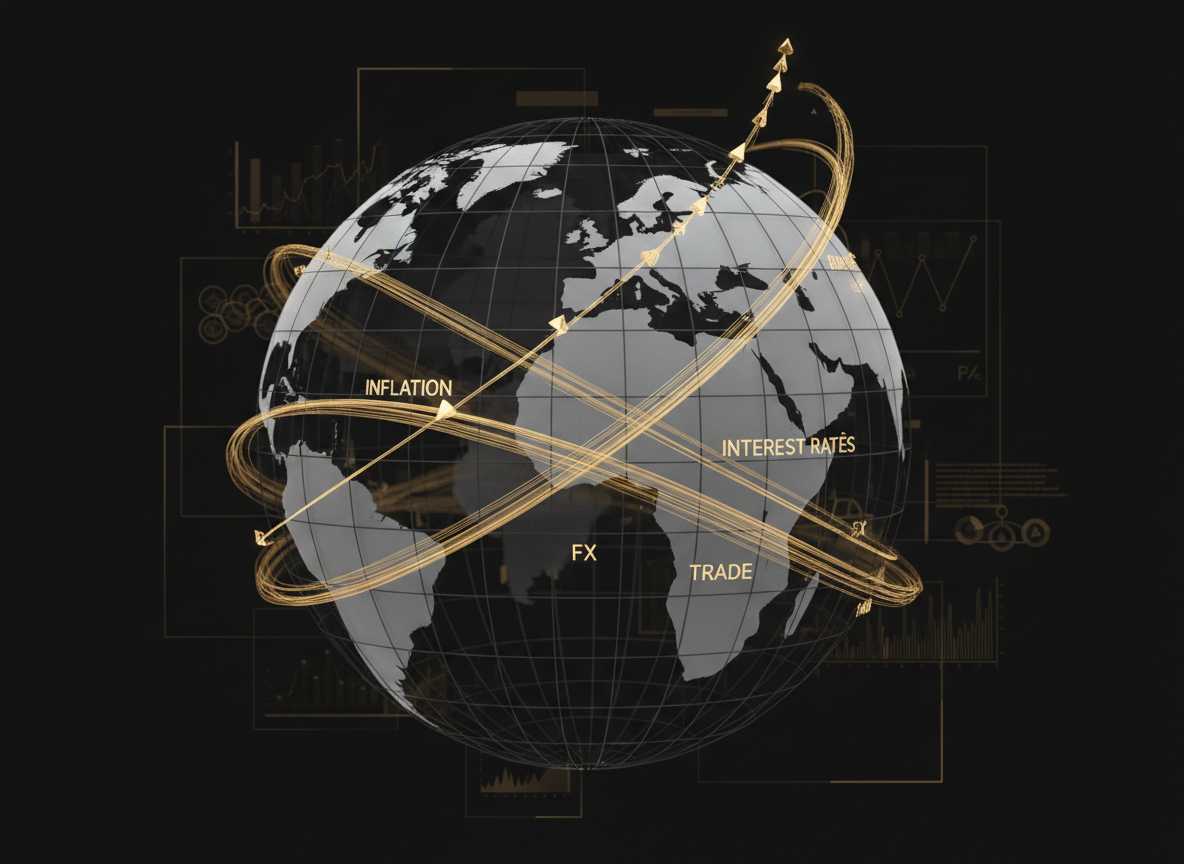
Sheyconomics translates growth, inflation, interest rates, trade, FX, capital flows and structural change into implications for investment cases, pricing, margins, market entry and capital allocation.
The objective is not to repeat the economic news. It is to understand what the data means for a specific company, portfolio, market or transaction.
When this work is useful
Economic analysis becomes most useful when leadership needs to choose between markets, test a pricing strategy, assess financing assumptions or understand how a macro shock could change demand, margins or valuation.
Market entry
Demand, income, FX, regulation, country risk and structural growth.
Investment case
Growth, rates, inflation, financing and downside sensitivity.
Pricing & margin
Inflation transmission, supplier costs, wage pressure and pricing power.
GLOBAL OUTLOOK 2026
A moderate-growth world still creates very different outcomes by sector and market.
3.1%
IMF projected global growth for 2026.
3.2%
IMF projected global growth for 2027.
2030
Scenario horizon for AI productivity, capital costs, trade and structural change.
Those global figures are a starting point, not the conclusion. The relevant question is how different inflation, rate, FX and trade paths affect the economics of a specific investment or operating plan.
Sources: IMF WEO, April 2026, World Bank GEP, June 2026.
Questions this work helps answer
- Which market offers the best risk-adjusted growth?
- How would higher rates or a weaker currency change the investment case?
- Can inflation be passed through without damaging demand?
- Where is margin most exposed to external shocks?
- Which assumptions should be monitored as leading indicators?
Three questions before trusting any 2030 forecast
Long-horizon economic forecasts are useful for framing a decision and dangerous when treated as a prediction. Before building a plan on one, it is worth asking:
What has to stay true for this number to hold? Most macro forecasts embed several assumptions about policy, trade and technology that rarely all move together.
Who benefits from this forecast being believed? Growth projections from a government, a bank selling the trade, and an independent multilateral rarely carry the same bias.
What would change if the number were off by a third? A plan that only works at the base case is a plan built on a forecast, not a decision built on evidence.
What a mandate can deliver
Macro dashboard
Growth, inflation, rates, FX and leading indicators.
Country / sector outlook
Decision-relevant context, not generic commentary.
Sensitivity model
How macro assumptions change economics.
Investment implications
What to monitor, hedge, change or defer.

